
When we sit down with councils to talk about kerbside EV charging, one question comes up more than any other: “What do we actually have to do?”
It’s a fair question. There are now several government and power company programs supporting kerbside charging, each with its own rules, timelines and lead organisation. From the outside, it can look like a lot of paperwork for a council team that already has plenty on its plate.
The good news is that council’s role is usually smaller, and more focused, than people expect.
Council Doesn’t Need to Run the Chargers
In most cases, council does not apply for the funding, buy the chargers or operate them. Charge point operators, like EVX, and electricity networks do that work.
What council brings is local knowledge and local authority. Council decides where public charging makes sense in the community, and provides the approvals needed to install it. That’s an important role, because council understands its streets, its residents and its parking pressures better than anyone.
How the Programs Differ
Each program supporting kerbside charging asks something slightly different of council:
- DCCEEW Accelerating EV Charging Program (Federal): your electricity network leads. Council comments on site suitability, parking and approvals as sites are identified in three tranches between January and June 2027.
- Essential Energy Plug & Play: Essential Energy leads, and council helps prioritise poles, parking and local approvals across country NSW.
- EVX ChargeKonnect: EVX leads, working with council and the local electricity network to identify and approve suitable kerbside locations.
Which programs apply to your council depends largely on where you are, including which state you’re in and which electricity network serves your area.
A Simple Six-Step Path
Rather than starting with a program and working backwards, we recommend councils start with their community and let the program follow the site. In practice, that looks like six steps:
- Need: where is public charging genuinely needed? Think streets with little off-street parking, and activity centres where people already spend time.
- Operator test: which of those sites would an operator actually install and run?
- Network test: which poles and how much capacity can the local electricity network support?
- Local approval: what parking, accessibility and traffic conditions apply?
- Program match: which program fits each site, without funding the same cost twice?
- Delivery: the operator or network installs, operates and reports.
What This Looks Like in Practice
The City of Ryde is a good example. Council consulted residents in two rounds and endorsed 23 dual-port locations, which were installed by EVX.
The common thread in councils that move quickly is that they start with community needs, bring in an operator and their electricity network early, and keep control of where the chargers go.
How EVX Can Help
Our team works with councils to test priority areas against what operators and networks need, and to build a single site list that can feed every relevant program. Council doesn’t need to become a grants expert. That’s our job.
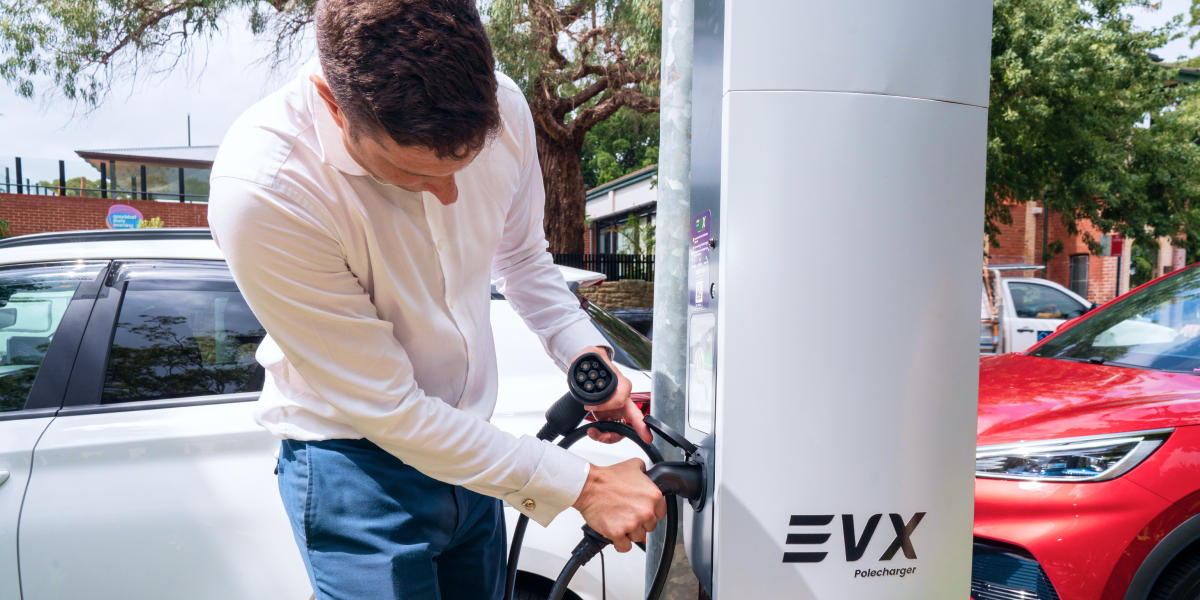
Every EVX Polecharger is designed and made in Australia, mounts on an existing power pole, and runs on 100% renewable energy, so there’s no new street furniture and minimal disruption for residents.
If your council is weighing up kerbside charging, let us know and we’ll arrange a briefing for your team.